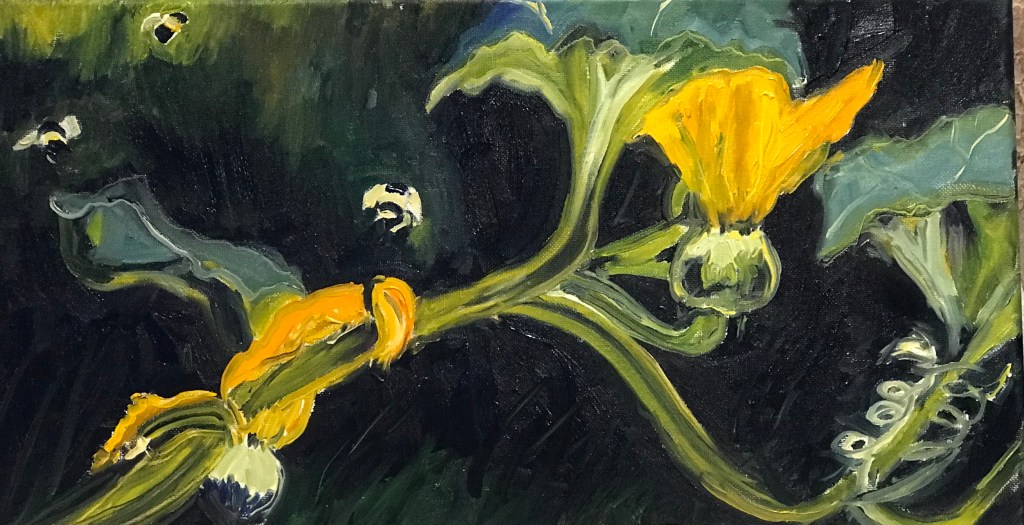
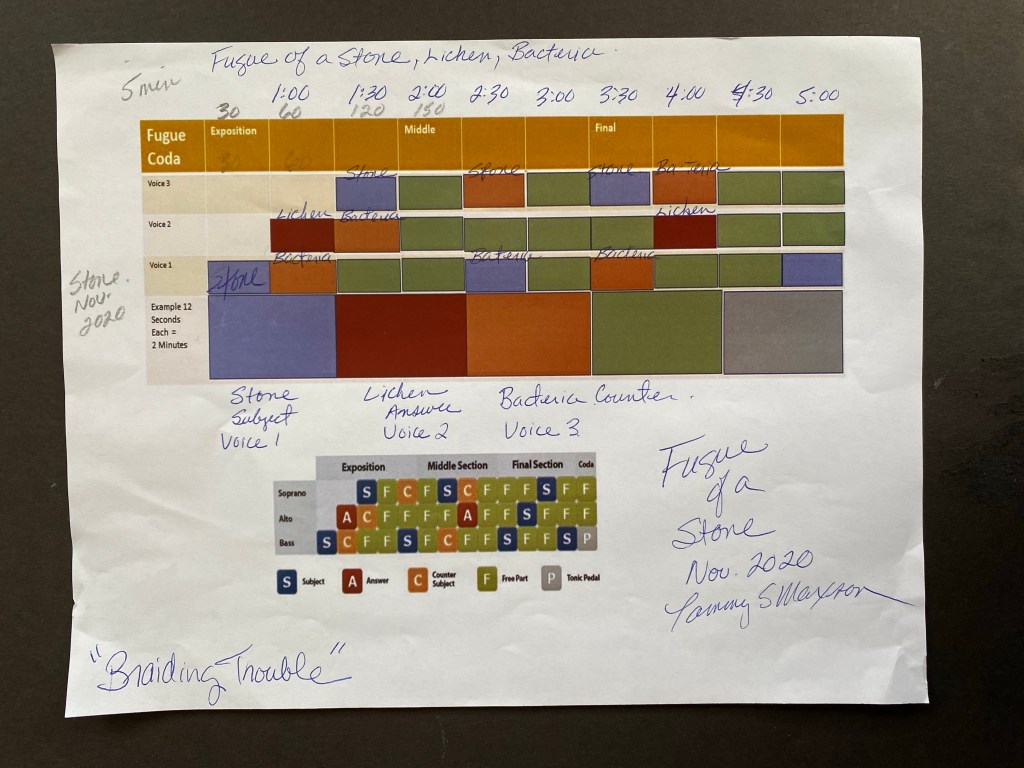
Because my project is a time-based project. The visual aspects may not be fully realized in my lifetime or maybe not for many years. I have come to depend on other sensory components to tell the story of the project. I have been using my voice to story tell, manifest, and make connection. However, this is just the surface of the reason I use my voice to speak. It is the sound of my voice the tone, the frequency, the emotional connection that I am trying to produce. I have been playing with polychoral audio mixing of my voice trying to maybe recreate a hymn or chant. Layering my voice to make something more. I didn’t really know where I was going with this practice. The Gregorian monks use a scale, a frequency that is meditative and healing. Last fall I played with the polychoral and fugue as an artist practice but I think I may now go in the direction of solfeggio frequency and elemental sounds. The ecology of my place is unbalanced, part of what I am doing is healing this unbalance. All of this is reflective of my own need for healing and rebalance. Maybe through this practice I can look at healing through voice, pulling my audience into the story with my tone, and posable manifest a healing of place and a healing of self.
I am moss. I sit here with my sisters. Our leaves quiet and still. We have sat here for so long waiting for it to rain. The dew in the morning is gone and I fear for us. I fear for my sisters at this time. We wait. We just wait, protecting our small males under our lacy, hairy leaves, giving them shelter. We wait here in the sun, waiting for the moisture, knowing or hoping that this time will change. When water was plentiful, we worried that the rain would not come. But now that it has not come, we endure. We endure. I fear for them, my sisters. I fear for myself. And I fear for my children who wait to be spores. We will not send them out yet. We will wait for it to be plentiful again. We wait for the rain. We wait for the water. We wait for change. We endure.
I am the sugar maple, old and gnarled. The cold snow lies on my feet and legs and I sleep. My leaves are gone, and the sky is gray, and the air is cold. Just little tiny buds at the ends of my fingers’ tips show that I may come back to life soon. Where is my moss coat? The one that keeps me warm when the wind blows. When it gets bitter at night. Where is my moss? Where did she go? Did she find it hard to breathe this gray air? Where did the moss go? Blue, green lichen clings to my side, but she does not keep me warm. Where is the moss? Where did she go?
I am a fungi. I live inside my sister. She was old and starting to pass away from this world. She had given all she could give. She had given her breath, her children, her time, and I came inside of her to be with her, and as she leaves, I take that space and I hold her strong. Some would say that I am a parasite, but she knows I’m not. I hold her close as she passes. I do not let her be alone. Slowly, we are one, and then slowly, there is just me.
I am a girdled apple tree. She comes for me under the heavy snow. She crawls towards me, digging, scooting, crawling under the snow. The weight is heavy on her, but she still, she comes for me. She nibbles and eats at my fingers, at my toes. She nibbles and eats my mind. Always taking and eating and consuming. She gnaws at my trunk. She encircles me, going, taking, a little more each time. Gnawing, taking, a little more. Consuming me. Around she goes, coming around. Will there be enough left to survive? Will she make it all the way around? Before her hunger is satisfied? Will I survive? I am so thirsty.
I am water. I fall from the sky. I am a part of all of you. All life is a part of me, and I’m a part of you. I fall from the sky onto the ground, and in your field I collect and swell into a stream. I’m held into that stream of water. I’m held there, and I soak into the ground. I flow past your roots. I flow out from that swale, from that stream. I soak into the ground.
I go maybe where you can’t see me; and given enough time, I will quench that deep thirst in the ground. Don’t allow me to run amok and wash away the soil. Don’t feed me poisons that I will pass on to others. Allow me to soak into the earth. Allow us to be together so that we may feed you. Allow us to be one. Allow me to be the blood in the soil, the body, and give life to our children.
It’s spring again, and I’m watching it rain. And I’m thinking about how the project started. And the first thing that I had to consider was water, and rain, and gravity, and I researched and decided to sculpt the earth. So that’s what I did. I used a piece of machinery I did and a shovel, and I sculpted the field so that the area that was above the site was directed towards the site. So I just took the land and just kind of like shaped it and it’s just a rolling kind of shape that focuses to the area that the orchard was going to go into.
If I tried to do it now, it would be very difficult. This was something I had to sculpt in the very, very beginning. And there was also the hugel mounds. The water was to be absorbed into the hugel mounds to hold the water in place for when it didn’t rain. And being under the earth, it was able to suck up water like a straw and just hold it there. So I sculpted the mounds to hold water.
The other consideration was actually mycelium. This was also important to hold the water to the plants. Mycelium has a beautiful relationship with its co-species and they communicate between species. They receive sugars from trees in exchange for nutrients. It’s just a beautiful symbiosis. But they also hold a lot of moisture to that area. So incorporating the mycelium was really important. I also went to the wild apple trees and took some of the windfalls and I actually planted them into the mounds too so that the mycelium that was in the trees would be inoculated into the mounds and see if I could start that relationship in the orchard.
I’m also going to incorporate morels. Morels have a relationship with old orchards. I’m not sure why it’s old orchards that have this component, I’m going to research more, experiment more. But I would like to also try to build this relationship. I have some ideas about how to do this by planting the morels in jars, that I will plant in the soil on-site so that they can start to build that relationship in around the jars that will protect the mycelium until the trees can give enough shade to do this themselves.
But definitely sculpting was a huge part of water harvesting. I also sculpted swales. I have one that encircles the entire project, and now that it’s spring and it’s raining, I can actually see the water running over and under the ground through little holes And I know this is a soil type that the clay holds it at a certain point and the ground water runs over it. But anyway, so I can see it actually go into the swales and fill the swales, which was the plan. So I can actually see the gully that I sculpted running towards, not directly, I didn’t sculpt it straight down. I wanted this gentle sloping so that the water would slow down and be absorbed into the site and not just wash away the soil.
I have to put some thoughts into what kind of plantings I will do above site to hold soil so it doesn’t get washed away. So this entire first year is about water retention and how to hold it to site without drowning the plants and with the mounds holding their roots above, they can use their roots to go to the source and not drown in water.
So a lot of thought has gone into the rain and the water and water harvesting and sculpting earth. And I’m seeing the benefits of it now from this sculpting a year ago, when it was very dry. And then we went into a drought into the fall and I could see that the water was harvesting through the winter, but it’s really now that I can see gravity working and I can see the water system that I put a lot of thought into to benefit these trees and ecosystem that I’m sculpting and building, I’m hoping this will last for hundreds of years. So the thought into just the structure is so vital because it’s hard to go backwards. So yeah, water, rain, soil. All really, really vital.
In the image for a presentation for Girdled, a piece of artwork where a girdled tree is placed upside down on a canvas, and the words of her desperation are also embedded in beeswax on the surface. I plan to make this project in the summer of 2021. And I feel that this project is a representation of our world. We are the voles. We are the rodents. We are taking just a little bit more all the time because we want more, and we’re not satisfied yet. And we keep taking. Even though if we get all the way around and the tree dies, we can’t consume it anymore.
Speaker 1:
And I feel like that is this moment in time. There’s a urgency, a desperation, and we’re going to get thirsty, and the earth is going to get thirsty. And if the earth is thirsty, she won’t be able to feed us anymore because her life will die back. And she’s starting to get thirsty already. The rodent is gnawing and chewing and does not think about that. If they just left enough, they would be able to survival. If they didn’t go all the way around, life could continue.
First day of spring. The snow is almost all melted. I can hear it gurgling under the ground. It makes everything here very wet and soaked, and I can just now start seeing just little edges of green. People are out right now, looking for leaks, collecting sap to make syrup. The birds are coming home and looking for nests. And the sun is just a little warmer than it was yesterday.
I have yet to see the first robin, but I’m patient. I see leftover nuts on the ground. I was saddened to see that the brook trout were missing, but I know somebody needed to eat during the winter so I’m happy that somebody didn’t go without.
The wind blows, but it’s not quite as bitter. The trees are right now pulling the sap from their toes, up into their limbs, up into their trunks, through their branches. You can almost feel the movement…sound of peepers.
 Tammy Skiver Maxson